Showing posts with label Pork. Show all posts

Wednesday, 18 May 2022

Tortilla de Grelos y Jamon

Tortillas in Spain are almost always eggs and potatoes, with or without onion (and they will fight about it). I frequently see assurances that tortillas can be made with other fillings, but actual examples are very rare on the ground. 

This take is Basque in origin, and makes a very nice change. I find green vegetables a little short in supply in official Spanish cuisine, but given the number of little gardens clustering every small village, people must eat 'em. Any kind of spring green such as turnip greens or raab, or arugula maybe, could be used here. Spinach is probably most readily available here, but something a little more robust would be the best. Good Spanish ham is also ideal but hard to get. Good Canadian ham will work okay, but it too is hard to get these days - so much of it is soaked in brine and gelatine. Don't bother with that. Use a good bacon if you have to (also not soaked in brine... good luck).

2 to 4 servings
30 minutes - 15 minutes prep time
 
Spanish Tortilla with Ham & Greens
 
1 green onion OR shallot
300 grams (10 ounces) turnip greens OR spinach
150 grams dry ham or cooked bacon bits
6 large chicken eggs
salt & freshly ground black pepper to taste
2 tablespoons olive oil
 
Wash, trim, and chop the onion or shallot. Wash, trim, and chop the greens or spinach. Put them in a mixing bowl. Chop the ham and add it, or if using bacon, chop it and fry it until crisp but not browned. Drain the pieces of excess fat and add them. 
 
Break in the eggs, mixing them in one at a time. Season with salt and pepper to taste. 
 
Heat the oil (or you could use the bacon fat if you have it; but use it in a clean pan to avoid sticking) over medium heat in a large skillet. Once the pan is hot, spread the egg mixture evenly in it.  

As it sets, you can lift it up and tilt the pan to allow raw egg to flow underneath. When it is about half cooked - the top will still be not set - carefully flip it out onto a plate by placing the plate over the pan then turning them both over. Slide the tortilla back into the pan, and pour any raw egg remaining on the plate around the edges. Cook until the tortilla is set, but not dry. 

In Spain, this would be served at room temperature, cut into slices - in a sandwich, maybe - or cubes to be eaten as tapas, but you can eat it right away as you would any other omelette if you prefer.


Friday, 13 May 2022

Stuffed Tau Pok

Last time I was in a civilized place - and apparently my definition of "civilized place" is "has a Chinese/Asian grocery store" - I stocked up on tau pok. It freezes extremely well, and I freely admit it is my favourite form of tofu. In spite of consisting of deep fried chunks, it is really not greasy and the resulting chewy/airy texture is terrific. If you think you don't much like tofu and it is the texture that puts you off, this is a good way to try it again and see.

There are a number of traditional recipes for stuffing and steaming tau pok. My take on it combines things from 2 popular versions, mostly as a matter of expedience; other than the tau pok itself these are all ingredients I can get around here. 

I found the oyster sauce added a necessary punch of saltiness to these - in spite of the fish sauce, they were not really salty in themselves. If you don't have any oyster sauce, add a bit more fish sauce or double the salt in the filling.
 
16 to 20 pieces
1 hour - 20 minutes prep time
assumes puffs are steamed in 2 batches


Fried Tofu Puffs Stuffed with Meat and Green Onions

250 grams (1/2 pound) ground pork OR chicken
2 tablespoons fish sauce
1/4 teaspoon salt
freshly ground black pepper
1 tablespoon arrowroot OR corn starch
1 tablespoon finely grated fresh ginger
2/3 to 1 cup finely chopped green onion OR chives
2 teaspoons mild vegetable oil to oil dish
1 package (185 grams; 6.5 ounces) fried tofu puffs (tau pok)
about 1/2 cup chicken stock
oyster sauce
cilantro 

Put the ground meat in a bowl with the fish sauce, salt, pepper, and arrowroot. Peel and grate the ginger, and add it. Wash, dry, trim, and chop the green onions or chives very finely and add them. Mix everything very well. 

Set up your steamer; it should hold the stuffed tofu in a dish. Mine would only hold half at a time so I set up 2 dishes to go into it. Lightly oil the dish or dishes, and turn the heat on under the steamer. If you are doing it in two rounds, be sure there is plenty of water in it, or that you can add boiling water to top it up if needed. 

Meanwhile, stuff some tofu. Cut a slit in one side (top) of each puff and put in a bit of the filling You can stuff in more than you might think and I found it useful to score off the bowl of filling to make sure it was being more-or-less evenly divided. There were 18 puffs in my package, but they are plainly hand-cut and varied a bit in size so quantity may not be exact either. Arrange them in the oiled dish(es) in a single layer, stuffing up. Place them in the steamer and pour a little chicken stock on them; just enough for them to be sitting in about 1/4" of it. Steam for 20 minutes. If you have a rack or similar thing that can go under the plate to be steamed, and which has handles to allow it to lift the plate out, that is very helpful.

If you have a second dish, check the water level, and steam it for 20 minutes with a little chicken stock in the same way. 

These will be very hot when they come out, and the spongy tofu holds some of the broth to burst out and burn you when bitten, so let them sit for a full 10 minutes before serving. Garnish them with a drizzle of oyster sauce and a sprinkle of chopped cilantro, if you like. 


Last year at this time I made Sorrel Soup.

Monday, 18 April 2022

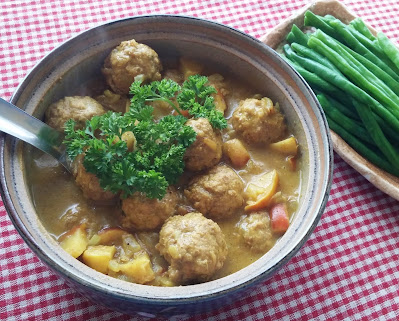
Danish Meatballs in Curry Sauce

Everybody knows Swedish Meatballs! And they're delicious, no question. But rich, very rich. You would expect the Danes - who make some wildly rich dishes themselves - to try to out-do them, but in fact this popular Danish meatball dish is fairly restrained, especially if you use ground chicken. Or turkey. I didn't list it but more because I was running out of room than because I don't think you could use it. So this is really more suitable for cooking on a regular basis, and it's also quicker and easier to make.

Just like any Canadian "curry" from the past, it calls for an apple to add a little sweetness. A touch of lemon then sharpens it up. It's usually served with rice, but potatoes or noodles would be good too. Just add a green salad or vegetable to finish your meal.
 
4 servings
45 minutes prep time
 
Danish Meatballs in Curry Sauce
 
Make the Meatballs:
500 grams (1 pound) ground veal, chicken, OR pork
1 small onion 
1 large egg
3 tablespoons wheat flour OR toasted barley flour
1 teaspoon salt
freshly ground black pepper to taste
the finely grated zest of 1/2 lemon, optional
a little milk if needed
2 or 3 tablespoons minced parsley, if possible
3 cups chicken or vegetable broth

Put the meat into a mixing bowl. Peel and mince the onion, and add it, along with the egg and all the seasonings. Mix well and form into 20 or 24 equal balls. 

Bring the broth to a boil in a heavy-bottomed soup pot. Gently add the meatballs and simmer for about 20 minutes. 

Make the Sauce:
1 small onion
3 tablespoons unsalted butter
1 large apple
3 tablespoons wheat flour OR toasted barley flour
2 tablespoons Madras curry powder
salt & freshly ground black pepper to taste
the juice of 1/2 lemon OR 2 tablespoons apple cider vinegar

Meanwhile, peel and mince the onion. Heat the butter in a medium skillet over medium heat. Add the onion and cook gently. While it cooks, wash and core the apple, and cut it into dice. Add it to the onion to sauté. Stir regularly. 

When the onion and apple are softened, sprinkle the curry powder and flour over them. Mix in well and let cook for another minutes until no dry powder is visible. Season with the salt and pepper. 

Scrape them into the pot of meatballs, and mix in gently but well. Add the lemon juice. Simmer for another 5 to 10 minutes, until thickened.

Serve at once over steamed rice.


Last year at this time I made Spinach Tortilla Wraps

Friday, 25 February 2022

Bulgarian Princesses

This traditional Bulgarian dish was commonly made when making sausages; leftover filling was spread on bread and broiled. It then went on to became a popular snack whether sausages were being made or not. You can season the meat however you like, really, although this was a pleasant combination.
 
Why are they called Princesses? No idea. It sounds a bit cannibalistic, but I hope the actual implication is that they are good enough for a princess. Not one of your sits-in-a-tower-embroidering princesses, but an I'm-also-a-general-in-the-army type princess, with a hearty appetite. 

My beef (and given the relatively small amount needed, it was only beef) is grass-fed and therefore very lean. This is a dish that needs a little fat in it, to melt into the bread and give it the perfect texture. Not too much though; I added a scant tablespoon of bacon fat to my mixture (before the egg, so I could get it well-distributed) and it worked perfectly. 

Why yes, these really are a lot like an open-faced hamburger. More fun, but I think some pickles and slice of tomato would do them nothing but good. Salad is a great accompaniment for them. I say nothing of French fries.
 
4 servings
20 minutes prep time
 
Bulgarian Princesses - Open-Faced Grilled Meat Sandwiches

3/4 teaspoon cumin seeds
1/4 teaspoon black peppercorns
1/2 teaspoon salt
1 teaspoon rubbed savory
1 teaspoon sweet smoked paprika
1 or 2 cloves of garlic
1 tablespoon minced parsley, OPTIONAL
250 grams (1/2 pound) slightly fatty ground beef
  OR beef and pork mix
1 large egg
1 medium baguette
  OR 4 crusty buns
 
Grind the cumin and pepper with the salt, then mix all the spices in a mixing bowl. Peel and mince the garlic, (and mince the parsley) and add it along with the beef. Mix well, then mix in the egg. 

Preheat the oven broiler. 

Slice the bread or buns. Toast them lightly under the broiler, then turn the oven heat to 400°F. Spread the buns with the beef mixture while the oven heats, then bake them for 8 to 10 minutes until the meat is done. If the meat is done but you think it could have a better colour, put the princesses under the broiler for a couple of minutes. Serve hot, garnished with a sprinkle of parsley, if possible.


Last year at this time I made Bachelor's Baked Hash. Huh. Do I want meaty, carby comfort food all the time at the end of February? Apparently.

Monday, 3 January 2022

Quick-Braised Pork Chops with Caramelized Onion and Mustard Gravy

As the photo shows, I cooked 3 chops, but this is a highly scalable recipe. Feel free to use plain or smoked pork chops. Ham steak would work very well here too. Best served with a mountain of mashed potatoes (or Clapshot would be excellent) to soak up all the delicious gravy. A perfect antidote to winter blues. 

Mustard becomes very mild with cooking, so you may wish to add some more at the end, or just pass the bottle at the table for people to add their own.
 
4 servings
1 hour 30 minutes prep time
 
Quick-Braised Pork Chops with Caramelized Onion & Mustard Gravy

4 medium (1 kg; 2 pounds) pork chops 
4 tablespoons apple cider vinegar
2 tablespoons Dijon mustard
4 medium onions
2 tablespoons mild vegetable oil
2 cloves of garlic
1/2 teaspoon rubbed thyme OR tarragon
freshly ground black pepper to taste
2 tablespoons wheat OR barley flour
1 tablespoon bacon fat OR mild vegetable oil
1 1/2 cups ham OR chicken stock
1 tablespoon Dijon mustard, optional
 
Rub the pork chops with the vinegar then the mustard, and lay them on a plate. Let them marinate for about an hour. 
 
Peel and cut the onions in half, then slice them in half-moons. Heat the oil in a large skillet over medium to medium-low heat, and cook the onions gently for about 40 to 45 minutes, stirring regularly, until greatly reduced in volume and golden-brown. Remove them to a plate. 
 
While the onions cook, peel and mince the garlic and put it in a small bowl with the other seasonings except the extra mustard, and with the flour. 
 
Wipe out the pan, add the bacon fat, and cook the chops over medium-high heat until lightly browned on each side; about 3 minutes per side. Remove them from the pan. Add the bowl of seasonings to the pan and cook for a minute, mixing well, until there are no specks of white flour left. Slowly stir in about 1/4 of the stock, working out any lumps. Keep adding stock and stirring until it is all in and you have a smooth sauce; lower the heat if necessary. Add the pork chops, working them down into the gravy. Divide the onions evenly over the tops of the chops. Simmer steadily for 15 minutes, shaking the pan gently occasionally to make sure they are not sticking. 

Let rest 5 minutes and serve with the gravy, or remove them from the pan to rest and stir a bit more mustard into the gravy, which should be poured over the chops when they are served. 


Last year at this time I made Sweet Potato Biscuits.

Friday, 31 December 2021

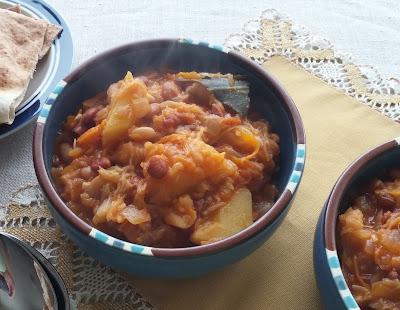
Jota - Slovakian Bean & Sauerkraut Stew

It's the end of the year, so it's the end of the year lucky bean dish. This traditional Slovakian dish usually has a variety of smoked pork products added to it, but I didn't happen to have any and wanted to keep it a little lighter. It's still a pretty substantial meal. I did use some bacon fat, but some kind of vegetable oil is all it needs to be vegetarian. If you want to use some meat, cut it in chunks (unless it's on the bone) and cook it with the beans once the water has been changed. 

I have to say though, my end of the year lucky bean dishes are not doing the trick. I would be happier to see the end of 2021 if I thought 2022 would be any better; I think it's going to take more than beans though. Here's to good luck to us all...
 
4 servings
1 hour - 30 minutes prep time 
NOT including cooking the beans
 
Jota - Slovakian Bean & Sauerkraut Stew

1 cup dried borlotti or pinto beans
1 teaspoon salt
2 medium onions
1 medium carrot
2 or 3 medium potatoes
2 or 3 cloves of garlic
1 tablespoons bacon fat OR mild vegetable oil
2 bay leaves
1 tablespoon sweet smoked paprika
1/4 to 1 teaspoon hot smoked paprika
1/3 cup tomato sauce
2 cups sauerkraut
1 tablespoon vinegar (optional)

Cover the dry beans generously with water, then bring them to a boil and boil one minute. Remove them from the heat, cover them, and let them soak for 2 hours to overnight. Drain them and add enough water to them to cover by about an inch. Add the salt. Simmer until tender, stirring regulary; about an hour. Or, cook them in an Instant Pot for 6 to 8 minutes. Allow to release naturally. This can be done up to a day ahead. 

Peel and dice the onions. Peel and grate or dice the carrot. Wash, trim, peel if you like, and cut the potatoes into chunks. Peel and mince the garlic. 

Heat the fat or oil in a large heavy-bottomed soup pot over medium-high heat. Cook the onions and carrots, stirring regularly, until softened and slightly reduced. Add the garlic, bay leaves, paprika, and Aleppo pepper and mix in well. Add the cooked beans with their cooking liquid, and the tomato sauce, and mix well. Mix in 1/2 of the sauerkraut. Add the potatoes when they are ready. Simmer the beans for 30 to 45 minutes, stirring regularly, until the mixture is thick and well-amalgamated. Keeping in mind that there is a little more sauerkraut to be added, taste and decide if you want it a little more sour, in which case add a spoonful of vinegar.

Once the beans have been added, put the potatoes in a separate pot and cover them with water. Bring them to a boil and boil for 12 to 15 minutes, until tender. Drain them and add them to the stew. 

Add the final cup of sauerkraut just before you are ready to serve, and allow it to just heat through.

This keeps and re-heats well, as with most bean dishes. 


Last year at this time I made Lentils with Smoked Sausage.

Wednesday, 1 September 2021

Cauliflower & Bacon Salad

Found this one in an old cook book. As usual, I forgot to note which one, but it dated to 1916. I added some parsley because it needed something more. It's still a very simple salad and much depends on the quality of the ingredients, especially the bacon - be sure to get a good one. It does not need to be too lean because the fat will form part of the dressing, but it shouldn't be too fatty either. 
 
I've written this up on the assumption that you would make it from scratch, but in fact this is probably best as a use for leftover cooked cauliflower. Scale the other ingredients to match the quantity you have; but I suspect that if you are not terribly precise it doesn't matter much. 
 
4 to 6 servings
20 minutes prep time
 
Cauliflower & Bacon Salad

4 cups cauliflower florets
1/3 cup finely minced chives
1/3 cup finely minced parsley
225 grams (1/2 pound) bacon
1 teaspoon Dijon mustard
salt & freshly ground black pepper to taste
3 tablespoons apple cider vinegar
 
Wash and trim the cauliflower, and break it into smallish bite-sized florets. Wash and dry the chives and parsley, and mince them finely. Chop the bacon.
 
Boil or steam the cauliflower until just tender; about 6 minutes. Drain well. 
 
Just before the water for the cauliflower comes to the boil, put the bacon in skillet sufficiently large for it, and cook it over medium heat until crisp. If there is too much fat - you want about 3 tablespoons worth - drain some off. Have the mustard, salt and pepper, and vinegar whisked together in a small bowl, and add them to the bacon as soon as you turn the heat off. Mix well, but be careful - it will spit and sputter quite a lot.

Pour this dressing over the very well drained cauliflower and mix well. Mix in the chives and parsley, and allow it all to cool to room temperature. Serve at room temperature.

Friday, 13 August 2021

Smoky Paprika Pork Chops

I got a bit bored with plain pork chops, and thought of seasoning them with smoked paprika to keep them simple but a little more lively. A touch of vinegar also sharpens the flavour, and possibly even tenderizes them slightly. The smoked pork chops I get have plenty of salt - sometimes more than plenty - but regular plain chops should be seasoned with it. So far I have only used sweet smoked paprika because that is what is in the cupboard at the moment, but I can't see why a hot smoked paprika wouldn't be good. Likewise I have only used apple cider vinegar thus far, but I intend to try others. (Not balsamic; I can't see it.)
 
per portion
5 minutes prep time, 1 hour rest time
20 minutes to cook
 
Smoked Paprika Pork Chops

smoked pork chops or ham steak, OR plain pork chops
apple cider OR other vinegar
smoked Spanish paprika, sweet OR hot
possibly some salt and pepper 

Use about 1 teaspoon of vinegar for each side of the chops, or a proportionate amount if using ham steak. Drizzle it on and rub it over both sides. 

If the chops are smoked, do not use any more salt. Otherwise, they may be salted lightly on both sides (and peppered in any case). Sprinkle smoked Spanish paprika over them - again, on both sides - until thinly but completely coated. Rub them again until it is a smooth, all-over coating. Let the meat rest on a plate in the fridge in a single layer for about 1 hour. 

Cook the chops however you usually would do so - I cook mine in a cast iron skillet over medium heat, and expect them to take 6 to 8 minutes per side, depending on how thick they are and how well-cooked you want them. They could be broiled, or cooked on a grill, for similar times.
 
However you cook them, let them rest for 5 minutes before serving them. 


Last year at this time I made Macedonian Eggplant Salad.

Monday, 9 August 2021

Ham & Cheese Stuffed Zucchini

I love stuffed vegetables in general, but there is something particularly appealing about stuffed zucchini. It's not just that they taste good, it's that they are absolutely the perfect shape and size (usually) for stuffing. Ham and cheese is so classic, and they work so well here with tender, mild zucchini. 

Tatume are the squash I mostly use to stuff these days, but any kind will do. As for the breadcrumbs, use whatever (slightly stale) bread you like. I tend to use a heavy German rye bread and be a bit skimpier with it than I'm calling for, but I presume most people will use something a bit lighter and fluffier.
 
4 to 8 servings

1 hour 10 minutes - 30 minutes prep time

Ham & Cheese Stuffed Zucchini


4 short, fat zucchini of 200 grams (1/2 pound) each
1/2 cup finely diced red, orange, or yellow pepper
2 to 3 shallots
1 tablespoon mild vegetable oil
1 teaspoon rubbed savory
salt & freshly ground black pepper to taste
150 grams (5 ounces) grated Cheddar or Parmesan mix
2 cups finely diced stale bread cubes, crusts trimmed
150 grams (5 ounces) cooked ham, finely diced
2 tablespoons mayonnaise
2 teaspoons Dijon mustard
2 large eggs

Put a large steamer on to boil. Wash the zucchini, and slice off the blossom scar. Cut them in halves lengthwise, and when the water boils, put them into it, cut sides up, and steam them for 10 minutes. Use tongs to transfer them to an oiled shallow baking dish that will hold them snugly in a single layer.

Preheat the oven to 375°F. 

Meanwhile, wash, trim, and finely dice the pepper. Peel and finely chop the shallots. Cook them in a small skillet over medium-high heat until softened and reduced; season them with the savory, salt, and pepper. Keep in mind how salty the cheese and ham will be and don't use too much salt; the pepper can be applied more heavily. When done, remove these to a mixing bowl to cool.

Grate the cheese. Add about half of it to the mixing bowl, along with the bread, trimmed of any particularly hard or brown crusts and diced. Trim any fat or gristle from the ham, dice it finely, and add to the bowl. Mix well.

When the zucchini are steamed and removed to the baking pan, take a sharpish spoon and scoop out the centres to within half an inch of the shells. Let them cool enough to handle, then chop the centres finely, removing and discarding any seeds which have started to form. Squeeze out any excess liquid from them, and add them to the bowl. Add the mayonnaise and mustard, then break in the eggs. Mix well, and let the mixture sit for 5 minutes before using to stuff the zucchini shells.

Bake the stuffed zucchini for 20 minutes. Sprinkle the remaining cheese over them, then return to the oven and bake for a further 20 minutes. Let them rest for 5 minutes before serving them. 


Last year at this time I made Feta & Goat Cheese Dip.

Friday, 23 July 2021

Hungarian Cold Ham & Egg Loaf

North Americans tend to scream in horror at the mere sight of savoury things moulded in gelatine. Try not to wake your neighbours, okay? 
 
Hungarians on the other hand, still seem to make quite a lot of these dishes. Possibly because they have always used plain gelatine and avoided sugary artificially flavoured mixtures (*cough* Jell-o *cough*) and avoided combining bizarre ingredients in the name of novelty. Everything here classically goes together nicely; no novelty involved, and nothing is the worse for that. This is a lovely lunch for a stupidly hot day; cool and refreshing, and substantial without being heavy. A bit of bread and salad is all it needs to be a meal, or this is the sort of thing that looks attractive and is very practical for buffet entertaining.
 
16 slices
40 minutes prep time PLUS at least 3 hours to set
 
Hungarian Cold Ham & Egg Loaf
 
6 large eggs
1/2 cup finely diced dill pickle
2 tablespoons minced parsley
2 tablespoons minced chives
1 cup ham OR chicken broth
1 tablespoon granulated gelatine
1/3 cup mayonnaise
1 tablespoon Dijon mustard
1/3 cup thick yogurt OR sour cream
salt & freshly ground black pepper to taste
10 thin slices (250 grams; 1/2 pound) deli ham
parsley and chives to garnish

Put the eggs into a pot with water to cover, and bring them to a boil. Boil for 1 minute, then cover them and turn off the heat. Let them sit in the hot water for 10 minutes. Put them in cold water to cool. Peel them, and cut them in half. Put the yolks in one mixing bowl, and mash them. Dice the whites and put them in another bowl with the diced dill pickle, parsley, and chives. 

Put the broth into a pot and sprinkle it with the gelatine. Once it has soaked for a few minutes, heat the stock until it is steaming and the gelatine dissolves completely when stirred, but don't let it boil. Let this cool as you continue. 

Mix the mayonnaise and mustard into the mashed egg yolks, then mix in the yogurt or sour cream. Season with salt and pepper. A good hit of pepper is desirable, but keep in mind that the ham, broth, mustard, and mayonnaise all contain salt - a brief pass over the bowl with the salt shaker is likely to be sufficient. 

Pour about 2 tablespoons of the broth into a large loaf pan, and make sure it runs all over the bottom and sides. Lay a slice of ham centred in the bottom of the pan, then place a slice at each end, overlapping the first slice but hanging over the side of the pan - this will be folded over the filling to encase it. Add two more slices in the same way to each long side of the pan. Set one slice of ham aside for the top.

Mix the remaining stock into the egg yolk mixture. Add the egg whites, etc, and mix them in. There should be 2 remaining slices of ham; chop them finely and mix them in as well. Pour this mixture into the ham-lined pan and spread it out fairly evenly. Fold the ham slices up to cover it, then top with the last slice of ham. 

My ham came with a piece of waxed paper; I pressed this onto the surface of the loaf and made sure it was completely flat and covered. Seal or cover the pan and set it in the fridge to set overnight or for at least 3 hours. 
 
To serve, set the pan into a large pan of warm (tap) water for a few seconds. Run a butter knife around the edges to loosen it, then place a serving plate over it and flip it over to unmould. Garnish with a little parsley and some chives, if you like. Serve in slices. 


Last year at this time I made Polpette di Zucchine.

Friday, 2 July 2021

Deviled Ham

This has been a crazy busy year in the garden - they all are, but with Mr. Ferdzy engaged in building a fence and installing drip irrigation, it's been worse than usual - and I have been leaning hard on making dips and spreads such as Hummus and Red Pepper Paté once a week to have with bread and crudités or salad for lunches all week. Deviled ham works well as one of those spreads.

It requires a little - only a little - effort to make, but a piece of ham will be less expensive to buy than deli slices, and quite possibly better quality too, providing you choose carefully. As ever, avoid anything pre-cooked or pre-sliced, or full of brine and gelatine. 

This is quite a lot like my favourite Ham Salad, but smoother and spicier, although just how spicy is up to you. You could make sandwiches with it, but I like to put it out and have us serve ourselves as part of the experience.
 
6 to 8 servings
20 minutes prep time
PLUS 3 hours to set

Deviled Ham

1/4 cup ham or chicken stock
1/2 teaspoon granulated gelatine
200 grams (1/2 pound) diced cooked ham
1 shallot OR 2 garlic scapes
1 tablespoon or more Dijon or hotter mustard
1 tablespoon or more prepared horseradish
chile-garlic or other hot sauce to taste
1 tablespoon mayonnaise
1 tablespoon relish or sweet pickles 
2 allspice berries

Warm the stock, and put it in a small bowl. Sprinkle the gelatine over it, and set it aside for the moment. 

Cut the ham into dice, and put it in the bowl of a food processor. Peel and chop the shallot or scapes and add it as well. Add the mustard, horseradish, hot sauce to taste, the mayonnaise, and the relish. Grind the allspice berries finely, and add them. Process until the mixture is fairly smooth. Add the stock and gelatine, and process briefly again until blended. Taste it, and adjust the seasonings as needed.

Transfer the deviled ham to a serving dish, ideally with a lid, and keep chilled until serving time; allow several hours to rest. 


Last year at this time I made Green Pea Cutlets & Shirazi Salad

Monday, 17 May 2021

Spinach & Mushroom Salad with Warm Bacon Dressing

This is a classic German salad that's also long been popular here, as well it should be. You get to feel all healthy and virtuous about the spinach and herbs, but there's also mushrooms! And bacon!! And sour cream! Well, I'm using yogurt these days because I can't get a decent sour cream for love or money. Use a full-fat one for best results. I like to add toasted sunflower and pumpkin seeds for extra crunch. 

And here we seem to be, in salad season. 

2 to 6 servings
1 hour prep time

Spinach & Mushroom Salad with Warm Bacon Dressing


Prepare the Salad:
6 to 8 cups baby spinach leaves
8 to 12 small button mushrooms
a good handful of parsley, if available
3 green onions
1/4 cup unsalted sunflower seeds
1/4 cup unsalted pumpkin seeds

Wash the spinach very well in cold water, then pick it over, discarding any tough stems and damaged leaves. Rinse it well again, and dry it thoroughly - salad spinner is a good idea.

Clean, trim, and slice the mushrooms. Wash, dry, and mince the parsley. Wash and trim the green onions, and chop them finely. All of this, along with the sunflower and pumpkin seeds, should go into a salad bowl. You may, if you wish, keep the green onions out and cook them in the dressing instead - it depends on how mild your onions are, and how much you like them (or not) raw. Also, if they are not purchased roasted, you may wish to toast the seeds in a dry skillet for a few minutes over medium heat before they go into the salad bowl.

Make the Dressing:
1 clove of garlic
1 tablespoon Dijon mustard
2 tablespoons apple cider vinegar
freshly ground black pepper to taste
1/2 teaspoon sugar
maybe some salt
250 grams (1/2 pound) medium-lean bacon
1/4 cup sour cream OR thick yogurt

Peel and mince the garlic, and put it in a small bowl with the mustard, vinegar, pepper, and sugar. You MAY wish to add some salt, but it will depend very much on how salty your bacon is. Most commercial bacon is way too salty to need more added, but if you are getting good quality bacon a little salt may be beneficial - you will need to use your judgement.

Chop the bacon into pieces a little narrower than the width of the slices. Put them in a medium skillet over medium heat, and cook slowly until they have rendered quite a bit of fat and cooked to being quite crisp throughout.

Lift the bacon pieces out with slotted spoon and put them on a bit of paper towel to drain. Assess the amount of bacon fat you have in the pan. If you think there is more than the amount of oil you would use to dress the amount of salad you have, drain some of it off until it is the right amount. Otherwise, return it to the heat but turn the heat to medium-low. If you want to cook the chopped green onions, add them now and cook until well wilted, just a minute or so. Mix up the contents of the small bowl and mix them into the bacon fat. When well distributed, turn off the heat. Measure and mix in the sour cream or yogurt. Scrape the dressing over the salad. Toss well, then sprinkle the bacon bits over the salad. Serve at once.


Last year at this time I made Sweet Potato Starch Noodle, Spinach & Sprout Salad

Monday, 26 April 2021

Nem Nuong - Vietnamese Pork Loaf

Rice flour is the traditional ingredient for these, not too surprisingly, so I used the barley flour with a little trepidation. How much like actual Nem Nuong this actually is I can't say, but we thought it was delicious. Well - all that garlic; how not? The rice flour wasn't the only liberty I took. This usually has some meat curing salts in it, which I can't get and don't particularly want or need, so I just left them out. 

We ate it all quickly enough that I didn't freeze any, but I would think that you could.
 
4 servings
40 minutes - 15 minutes prep time
 
Nem Nuong - Veitnamese Pork Loaf
 
1 head garlic
2 tablespoons rice or barley flour
2 tablespoons fish sauce
1/2 teaspoon ground black pepper
2 teaspoons sugar
450 grams (1 pound) ground pork, not lean
1/2 teaspoon baking powder
2 tablespoons water
 
Peel the garlic, and pound it to a paste. (Grating it finely words well too.) Toast the flour in a dry skillet over medium heat, stirring as needed, until toasted to a paper-bag brown. Turn it into a mixing bowl with the garlic. 
 
Add the remaining ingredients up to the pork and mix well by hand. Dissolve the baking powder in the water and mix it into the meat. Put the seasoned meat into a seal-able container and refrigerate for 4 hours to overnight. 
 
Preheat the oven to 400°F. Bake for 15 minutes, then put it under the broiler and let it broil for 5 to 10 minutes, until browned in spots. 
 
Let it cool for 15 or 20 minutes or until completely cool, then slice and use to top salads or noodles, or as a component in spring rolls or banh mi. Obviously, keep leftovers well-wrapped and refrigerated. 


Last year at this time I made Crisp Fried Pork with Parsley Sauce.

Monday, 12 April 2021

Pulled Pork Caribbean Style

This is not quite any particular Caribbean style pork recipe, but pulled out elements from Cochinito Pibil, and Puerto Rican and Cuban Pernil (or Lechon) Asado. As usual with pork shoulder, a long slow cooking time is key. 

If you can't get achiote, replace it with 1 teaspoon ground turmeric. Orange - particularly sour (Seville) oranges are traditional in this, but a mix of lemon and orange juice works well, as do Meyer's lemons since they are a natural cross between a lemon and an orange. I've also made it with regular lemons only, and thought that was delicious. I have yet to make it with limes, but I certainly expect to at some point, and I suspect that will also be terrific.
 
10 to 12 servings
20 minutes prep time
12 to 24 hours to marinate
3.5 to 6 hours to cook 
 
Pulled Pork Caribbean Style

Make the Marinade:
1 tablespoon black peppercorns
1 tablespoon allspice berries
4 teaspoons cumin seeds
1 tablespoon achiote seeds
1 tablespoon rubbed oregano
1 teaspoon rubbed thyme
4 bay leaves
the finely grated zest of 1orange OR 2 Meyer's lemons
1 large head of garlic
2 pieces ginger root, 1" x 1" x 2" each
1/4 cup soy sauce
2/3 cup mixed lemon and orange OR Meyer's lemon juice

Grind the pepper, allspice, cumin, and achiote together. Mix them with the oregano and thyme. Put them in a container which can be covered and which will hold the pork roast fairly snugly. You could use a large zip-lock bag.

Grate the zest from the orange or lemon. Peel and finely mince or grate the garlic. Peel and finely mince or grate the ginger. Add these to the spices, along with the soy sauce and lemon or orange juice.

Marinate & Braise the Pork:
1.5 to 2.5 kilos (3 to 5 pounds) pork shoulder roast

Put the pork roast into the marinade, and turn it so that it is as evenly covered in it as you can manage. Cover and refrigerate for 12 to 18 hours; if it can be turned once or twice during the process, so much the better.

Preheat the oven to 400°F.
 
Transfer the roast with the marinade to a roasting pan. Roast for 30 minutes, then reduce the heat to 225°F and roast for 1 hour per pound of meat, or a little longer, until very tender and falling apart. Add a little broth or water to the pan if it appears to be drying out at any point. Cover and let rest for 10 minutes before serving.

If you like - and I recommend it - strain the cooking liquid while the roast rests, and serve some of it over the roast once it has been sliced (or pulled apart).


Last year at this time I made Rutabaga & Apple Soup.

Wednesday, 31 March 2021

Pizza Strata

Pizza is a pretty good way to use up some bits and pieces of this and that, and a strata is even better. One of your bits and pieces can be some fairly stale bread. You will need to be well-supplied with the cheese, eggs, and milk. This is also much easier than making a pizza from scratch. 

When I say mixed pizza toppings, I mean whatever vegetables you like to have on a pizza - for me that's onions, peppers, tomatoes, mushrooms, and green ones, too, when they are in season, which alas, they are not. But also things like the olives and anchovies, and the last of the deli meat, bacon, or pepperettes, the bottom of the jar of pesto, and so forth. If it's something you like on pizza, and you have it, put some in.
 
4 to 6 servings
1 hour 30 minutes - 30 minutes prep time
 
Pizza Strata with Salads

Soak the Bread:
8 cups diced stale bread cubes
6 large eggs
1 1/2 cups milk
salt & freshly ground black pepper to taste
2 teaspoons rubbed oregano
 
Cut the bread into cubes; something Italian seems appropriate. Whisk the eggs and milk together with the seasonings in a bowl sufficient to hold the bread, and add the bread. Let soak for about 10 minutes. 
 
Preheat the oven to 325°F. and lightly oil a 2 quart (8" x 10") shallow baking (lasagne) pan. 
 
Assemble & Bake the Strata:
250 grams (8 ounces) mozzarella cheese
2 to 3 cups prepared mixed pizza toppings, see note above
180 grams (6 ounces) ricotta cheese
1 to 1 1/4 cups tomato sauce 
 
Grate the mozzarella, and prepare your "pizza toppings". If you wish to use vegetables such as onions, mushrooms, peppers, etc, they should be cut into appropriate sizes sautéd lightly. Tomatoes should be salted and drained for a few minutes. 

Mix only half of the mozzarella in, but otherwise mix most of the prepared toppings into the soaked bread; crumble in the ricotta. 

Carefully transfer the mixture to the prepared pan and spread it out evenly. Top it with the tomato sauce. Run a wooden spoon through it to allow some of the sauce to get down into the mixture. Sprinkle the reserved toppings over the strata, and finish with the remaining grated mozzarella.
 
Bake at 325°F for 45 to 55 minutes, then let the strata rest for 10 minutes before serving.


Last year at this time I made Chicken Kerala Style

Monday, 1 February 2021

Almost Whole Stuffed Cabbage

This sort of stuffed cabbage dish is typical of southern France, and I've seen it made with a variety of meats or with salmon. It is neither cabbage rolls, nor a whole stuffed cabbage, but something in between. 
 
As many leaves as reasonably can be removed from a cabbage are blanched and re-assembled with a meat filling to form what appears to be a whole cabbage. It is actually a very simple dish to make; the only challenges involve selecting a cooperative cabbage and finding a good vessel to cook it in. I've seen it kept in a fairly convincing cabbage shape, often helped with some kitchen twine to hold it together, or pressed into a cake in a round casserole. Savoy is plainly the cabbage of choice here; their leaves are thinner, more flexible, and more tender than other cabbages. 

You should certainly feel free to use whatever meatloaf type filling you like here, and to season it to your taste, although I can report that this one worked well and was enjoyed very much.
 
6 to 8 servings
1 hour 30 minutes - 30 minutes prep time
PLUS allow 10 minutes to rest
 
Almost Whole Stuffed Cabbage
 
8 to 12 leaves from 1 large Savoy cabbage
1 medium onion
2 medium carrots
3 or 4 cloves of garlic
1 tablespoon mild vegetable oil 
900 grams (2 pounds) ground beef OR mix of beef and other meat
1 1/2 teaspoons salt
1 teaspoon rubbed thyme OR savory
1 teaspoon rubbed basil
1 teaspoon rubbed oregano
1/2 teaspoon Aleppo or similar hot pepper flakes
freshly ground black pepper to taste
2 large eggs
1 cup fine (quick cook) oatmeal
1 cup beef broth OR water
tomato sauce to serve (optional)
 
Put a large pot of water on to boil. Carefully remove 8 to 12 leaves from the cabbage, whole and undamaged. Trim the stems and shave them to be the same thickness as the rest of the leaf. When the water boils, add the cabbage leaves to it in 2 or 3 batches, and boil them for 5 minutes. Transfer them to a basin of cold water to cool as soon as they are done. Drain them well. 
 
This can be done up to a day in advance; wrap and keep cool until needed in that case. 
 
Peel and chop the onion. Peel and grate the carrots. Peel and mince the garlic. Heat the oil in a skillet over medium-high heat, and cook the onions and carrots until softened, stirring frequently (just a few minutes). Add the garlic and cook for another minute or so, then transfer the vegetables to a mixing bowl to cool. 
 
Preheat the oven to 350°F. 
 
Add the meat and seasoning to the cooled vegetables. Break in the eggs and add the oatmeal. Mix by hand until completely blended. 
 
In a fairly deep round or oval baking pan (about 2 quarts/litres) which has been lightly oiled, place the largest 2 leaves so that they slightly overlap at the bottom but otherwise look like they are growing out of the centre of your pan. Place a patty of about 1/8th of the meat mixture over them. Place another 2 or 4 leaves over it in the same way, and top with more of the meat filling. Continue until all the leaves and meat filling are placed. Fold the leaves over the filling to create the appearance of a whole cabbage. Because my baking dish was oval and not round, I ran some string under the cabbage leaves before I started and used it to tie everything into shape. 

Pour the broth over the stuffed cabbage and bake it at 350°F for 1 hour. Let rest 10 minutes before serving. If you like, serve it with hot tomato sauce poured over it. 


Last year at this time I made Perfect Fluffy Scrambled Eggs.

Wednesday, 30 December 2020

Lentils with Smoked Sausage

Lentils and other coin-like foods - like carrot slices, maybe - are traditional "good luck" foods for New Year's Eve, as is pork, for its richness. I can get some awfully good local raw smoked sausage these days, and I'm prepared to eat this at just about any time on account of how it's just plain tasty, as well as easy to make. I guess that sounds pretty lucky to me.
 
I don't usually soak lentils, but it does help speed them up for this. Of course, you could use tinned lentils and speed things up even more, or cook them ahead of time in the rice cooker (2 cups water to 1 cup of lentils). One cup of dry lentils is probably equal to about a tin and a half of lentils, so keep that in mind - you can round everything up a bit and put in 2 tins, no problem; it's that kind of recipe. 
 
Also if you can't get good Mennonite style raw but smoked sausage, you could go for a smoky cooked sausage, probably found where Polish style meats are sold. In that case I would use a little vegetable oil to sauté the carrots and onions, and add the sausage pieces when the lentils were half cooked.   

Okay; the last post wasn't quite the last post of the year - this one is. So once more, here's to 2021: may it be so much better than 2020. Let's hope!
 
4 to 6 servings:
1 hour 10 minutes - 20 minutes prep time 
 
Lentils with Smoked Sausage

Prepare the Seasonings:
2 to 4 cloves of garlic
1/2 teaspoon fennel seeds
1/4 teaspoon salt
freshly ground black pepper to taste
1 or 2 bay leaves
1/8 to 1/4 teaspoon crushed red chile (to taste)
 
Before you get started you should put your lentils (see below) into a bowl or pot and pour boiling water over them, and let them soak while you prepare other things. 
 
Peel and mince the garlic. Crush the fennel seeds with the salt. Put all of these into a small bowl and set aside until needed. 
 
Make the Stew:
1 large onion
1 large carrot
500 grams (1 pound) raw smoked pork sausage
a little mild vegetable oil, maybe
1 cup soaked brown OR green lentils
2 cups crushed tomatoes
3 cups water

Peel and chop the onion. Peel and dice the carrot. Cut the sausage into bite-sized pieces. 

Put the sausage into a heavy-bottomed soup pot, heated over medium heat. If it is lean you may want to start it in a very small amount of oil, but that's pretty unlikely. If it seems reasonably fatty, put in a few tablespoons of water to help it get started without sticking. Once it is sizzling and letting off some fat, add the carrots and onions. Cook for about 10 minutes, stirring regularly, until the vegetables are softened and reduced and the sausage is getting some brown spots. 

Add the lentils, and the seasonings from the little bowl. Mix in well and cook for a minute or so, then add the crushed tomatoes and the water. Mix well, and cook for about 45 minutes, until the lentils are tender. Stir regularly, and watch the liquid level. It should cook down some, but the mixture should stay stewy. You may need to add a little more water. Also check the salt - I'm calling for very little, because sausage can be quite salty. It's best to start low and add a little more if needed.

Serve hot, with good crusty bread if you can.


Last year's lucky dish was Roasted Chick Pea & Carrot Salad

Wednesday, 9 December 2020

Farserede Porrer - Danish "Stuffed" Leeks

This "traditional" Danish dish only dates back to the 1960s (as someone born at the beginning of that decade I refuse to consider that to be very long) but it has since become well-established. The simplest versions simply wrap the leeks in prepared sausage and bacon, but most call for home-seasoned ground pork and bread them in crumbs. I've put a little bacon on as a garnish, but it is not really required. (Although how can it even be Danish, if there isn't any bacon?) 
 
A thing I found amusing while researching this dish was the translation of the name. It gave Google Translate a fair bit of indigestion, because "farserede" means stuffed, but it has a literal meaning of "feathered". It took me a while to make the connection. Moreover, these are not leeks that are being stuffed with something, but leeks that are being stuffed into something, which is both linguistically and culinarily a bit peculiar. Results, however, are not peculiar but very tasty. This is a simple recipe that does not require many ingredients, but still manages to look quite sophisticated - always nice. 

Note what I say about cooking those leeks, and I find that even well-cooked whole leeks require steak knives.
 
4 servings
15 minutes initial preparation
45 minutes - 15 minutes prep time
 
Danish Stuffed Leeks - Leeks in Sausage

Prepare the Leeks & Stuffing:
2 large or 4 small leeks 
500 grams (1 pound) lean ground pork (could use turkey)
1 teaspoon salt
freshly ground black pepper to taste
a good scrape or 2 of nutmeg
2 tablespoons barley or other flour
1/3 cup milk
 
Put a pot of salted water on to boil, in which you will cook the prepared leeks. 
 
Trim and wash the leeks, and cut them into 4 logs of about 4" long, discarding the dark green top leaves, roots, and removing any outer leaves that seem tough or damaged. Boil them for 6 to 10 minutes, until tender when pierced with a fork. They will not get cooked much more than this, so they should be done to your liking. 

Meanwhile, put the pork into a mixing bowl with the remaining ingredients and mix, by hand, very well. The mixture should be quite smooth. Cover and keep refrigerated until needed. 

Drain the leeks thoroughly when done, let cool, cover, and keep refrigerated until needed. Both of these tasks can be done up to 24 hours in advance. 

Stuff & Bake the Leeks:
1/2 cup bread crumbs (I used hemp meal)
4 slices bacon
parsley to garnish
 
Preheat the oven to 400°F. Very lightly oil a shallow baking pan which will hold the stuffed leeks (1.5 to 2 quarts).
 
Put a piece of parchment paper large enough to roll the leeks in on a clean, dry countertop. Sprinkle about a tablespoon of crumbs into a square about an inch wider than the leek pieces, and about 4" or 5" long. Take 1/4 of the sausage mixture and pat it into a rectangle about 2" longer than the leek pieces, and wide enough to encircle them; over the crumbs in other words. Place one leek piece on the sausage, and use the parchment paper to roll it up in a neat cylinder. Seal the meat around the ends of the leek; it should now be entirely encased in crumb-covered sausage. Roll it in a few more crumbs if there are bald spots. Place it in the oiled pan, and repeat with the remaining sausage mixture and leek pieces. 
 
Place one strip of bacon lengthwise over each leek. Bake the stuffed leeks for 30 minutes, until lightly browned and sizzling. Let rest 5 minutes before serving, garnished with parsley. 


Last year at this time I made Leek & Oyster Mushroom Lasagne.

Monday, 16 November 2020

Brussels Sprouts Jackie Lau

I have generally shied away from vegetable dishes smothered in cheese and bacon. Of course it would be tasty! But the goal has always been healthy tasty vegetable dishes. 
 
Well, the world has changed and now cheese and bacon are health foods*, and it's sugar that gets the bad rap, as it should. (Mind you, I've always tried to avoid too much sugar in veggie dishes too). Then when I was reading "Her Big City Neighbour" by Jackie Lau - one of my favourite romance authors - and the main character went to a bar and ate Brussels sprouts smothered in cheese and bacon, I knew I would have to break down and make them.

Jackie Lau's books are a lot of fun, by the way. They are set in Toronto and around southern Ontario, so I get to see places I know moderately to very well through someone else's eyes. The stories have some real depth of emotion without ridiculous over-the-top angst, which is apparently a hard balance to achieve, while still being the light and fluffy escapism that I require so desperately these days in order to keep myself sane and functioning. 

Oh, the Brussels sprouts? As anticipated, very yum indeed. There's a bit of initial prep work, but then they are quickly enough assembled that they could easily be served as bar food.
 
4 servings
45 minutes prep time
 
Brussels Sprouts with Bacon & Cheese
 
500 grams (1 pound) Brussels sprouts
4 shallots
4 cloves of garlic
4 to 8 slices of bacon
1/4 cup light cream or stock
a little pepper and/or flaked red chile
1 cup grated Cheddar cheese
 
Put a kettle of water on to boil. Wash, trim, and slice or roughly chop the Brussels sprouts. Peel and sliver the shallots. Peel and mince the garlic. Cut the bacon into 1/2" pieces. Put the sprouts in a strainer in the sink, and pour the boiling water all over them. Drain well.
 
Cook the bacon over medium heat in an oven-proof skillet or stove-top safe casserole, until crisp. Remove it with a slotted spoon and keep it aside until wanted. 
 
If there is too much fat in the pan to cook the shallots and Brussels sprouts, pour it off, leaving about 2 tablespoons. Add the shallots and drained Brussels sprouts, and cook, stirring regularly, until done to your liking, a certain amount of browning being quite desirable. While they cook, put the broiler on to heat. 

When the sprouts are ready, mix in the garlic and seasoning well. Pour the cream or stock over them, then mix in the bacon. Sprinkle the cheese evenly over them. Put them under the broiler for 2 to 3 minutes, until the cheese is bubbling and lightly browned. Serve at once.


*Tongue, cheek; cheek, tongue.
Last year at this time I made Russian "Lazy" Egg & Cabbage Pie.

Monday, 19 October 2020

Costillas Guisadas con Patatas - Spanish Stewed Pork Ribs with Potatoes

It wasn't until I made Braised Pork Ribs with Squash that I discovered that ribs don't have to be slowly cooked in the oven all day. I mean, they are very delicious if that happens! But sometimes you want something faster, and stewing them works perfectly well and can be on the table in under an hour.

This is a very simple dish, with few ingredients, which is fairly typical of Spanish cooking. Half a kilo of ribs should be plenty enough, but that's what I used and I was a bit dismayed at just how very bony they were. As ever, the two of us ate it all, and it would have been better as part of the typical Spanish menu, with a "primero" of salad, and a "postre" of some sort. Maybe if you get better ribs it wouldn't be a problem, but this is what happens when you are not selecting your own groceries and just get what you are sent. Never mind! Very tasty and really, we are in no danger of starvation.

The peppers should be long Spanish or Italian type thick-walled fryers; bell peppers only if all else fails. I don't know why bell peppers persist in being so popular. They have a bitter aftertaste, and give plenty of people besides me indigestion. I used ham stock to make this, and so put in less salt than I am calling for - that amount assumes that you are using unsalted stock or water; adjust accordingly.

2 to 3 servings
50 minutes - 30 minutes prep time

Spanish Stewed Pork Ribs with Potatoes

500 to 750 grams (1 to 1/2 pounds) pork ribs
2 tablespoons mild vegetable oil
1 medium red pepper
1 medium green pepper
1 large onion
3 to 4 cloves of garlic
1 1/2 teaspoons sweet OR hot Spanish plain OR smoked paprika
1/2 teaspoon salt (or less, depending on stock)
2 cups ham or chicken stock, or water
500 grams (4 medium) potatoes

Cut the ribs into individual pieces. Heat the oil in a large, heavy-bottomed soup pot over medium heat, and brown the ribs on both sides.

While they brown wash, core, and cut the peppers into small dice. Peel and dice the onion.

When the ribs are browned on both sides, remove them to a plate. Put the peppers and onions into the pot and cook for 4 or 5 minutes, stirring regularly, until softened and reduced in volume - don't let them brown.

While the pepper and onions cook, peel and chop the garlic. When the peppers and onions are ready, add the garlic, paprika, and salt - if needed - and mix in well. Add the stock or water and let the ribs simmer for about 10 minutes.

While the ribs simmer, scrub or peel the potatoes and cut them into bite-sized chunks. Add them to the ribs, being sure that they are covered by the liquid. Add a little more liquid if needed; the ribs can be on top sticking out and that's fine. Put the lid partially over the pot and simmer steadily for a further 20 to 25 minutes, until the potatoes are cooked and the liquid is reduced to a thick sauce. Watch it carefully towards the end; you don't want it to get so thick it scorches. Again, a little more liquid can be added if needed.


Last year at this time I made Rye Apple Brown Betty.